

The short answer
AEO and GEO are about getting your brand named when a shopper asks ChatGPT, Google AI Mode or Perplexity what to buy. Those answers mostly draw on Reddit, YouTube, review sites and brands that are already talked about widely, which favors big players. Small D2C brands can still compete: make product pages answer real buying questions, publish honest buying guides, earn mentions on the sites AI cites, keep your catalog in Shopify and Google Merchant Center, and make sure AI crawlers can reach your pages.
What to take away
- AI shopping answers name only a few brands, so being left out costs more than ranking tenth on Google.
- Reddit, YouTube and review sites appear in most AI shopping answers, while big retailers are cited less than you might expect.
- Brands that are mentioned widely across the web show up far more often in AI answers than brands that aren't.
- There is no special schema or submit button. Clear product pages, honest guides and real mentions do most of the work.
- AI shoppers often click later or search your brand name, so measure branded search and ask buyers how they found you.
Ask ChatGPT for “gold huggie earrings for sensitive ears under $100” and you’ll get an answer with three to five brand names. Maybe a short reason for each, maybe a link.
If your brand is one of those names, you’ve just been recommended to someone ready to buy. If it isn’t, that shopper may never see you. There’s no page two to scroll to.
That’s the shift D2C and ecommerce brands are dealing with right now, and it’s what AEO and GEO are about. On Google, being in tenth place still got you some clicks. In an AI answer, only the handful of names on the list get seen. And so far, those lists lean toward brands that are already big and already talked about.
This post looks at what’s changed in 2026, who AI answers tend to favor, and what a smaller brand can realistically do about it.
What do AEO and GEO mean for a product brand?
AEO and GEO are two names for the same goal: getting your brand quoted or recommended when someone asks an AI tool what to buy. AEO is about being the page an answer engine quotes. GEO is about being named in answers from ChatGPT, Gemini, Google AI Mode and Perplexity. For an ecommerce brand, both mean making the short list a shopper actually sees.
The labels get thrown around a lot, so here’s the plain version of each.
- AEO (answer engine optimization) means making your pages the source an answer engine quotes when someone asks a question.
- GEO (generative engine optimization) means getting your brand named or cited in answers from tools like ChatGPT, Gemini, Google AI Mode and Perplexity.
For a product brand, both come down to one question: when a shopper asks an AI tool what to buy, does your brand come up?
It overlaps with SEO more than the hype suggests. Google says plainly that there are no extra requirements and no special schema for appearing in AI Overviews or AI Mode. Your page needs to be indexed and eligible to show in search. The difference is that AI answers rely much more on what other sites say about you, which is where big brands have the edge.
How AI shopping changed in 2026
Three things moved this year.
AI shoppers became valuable visitors. Adobe’s retail data for July 2026 showed AI-referred traffic to US retail sites up 62% year over year. Those visits converted 60% better than non-AI traffic and brought in 53% more revenue per visit. For most stores, AI is still a small slice of total traffic. But it’s growing fast, and the people who arrive tend to be ready to buy.
AI tools started plugging into store catalogs. In March 2026, Shopify made its merchants’ products discoverable in ChatGPT, Microsoft Copilot, Google AI Mode and the Gemini app through Agentic Storefronts, managed from the Shopify admin. Brands not on Shopify can add products to Shopify Catalog too.
Checkout inside the chat stalled, at least in ChatGPT. OpenAI launched Instant Checkout in 2025 with Shopify and Etsy among the first participants, then scaled it back in March 2026. Most ChatGPT purchases now finish on the merchant’s own site. Google went the other way: in February 2026 it launched checkout in AI Mode and Gemini for US shoppers, starting with Etsy and Wayfair, with Shopify, Target and Walmart named as coming next.
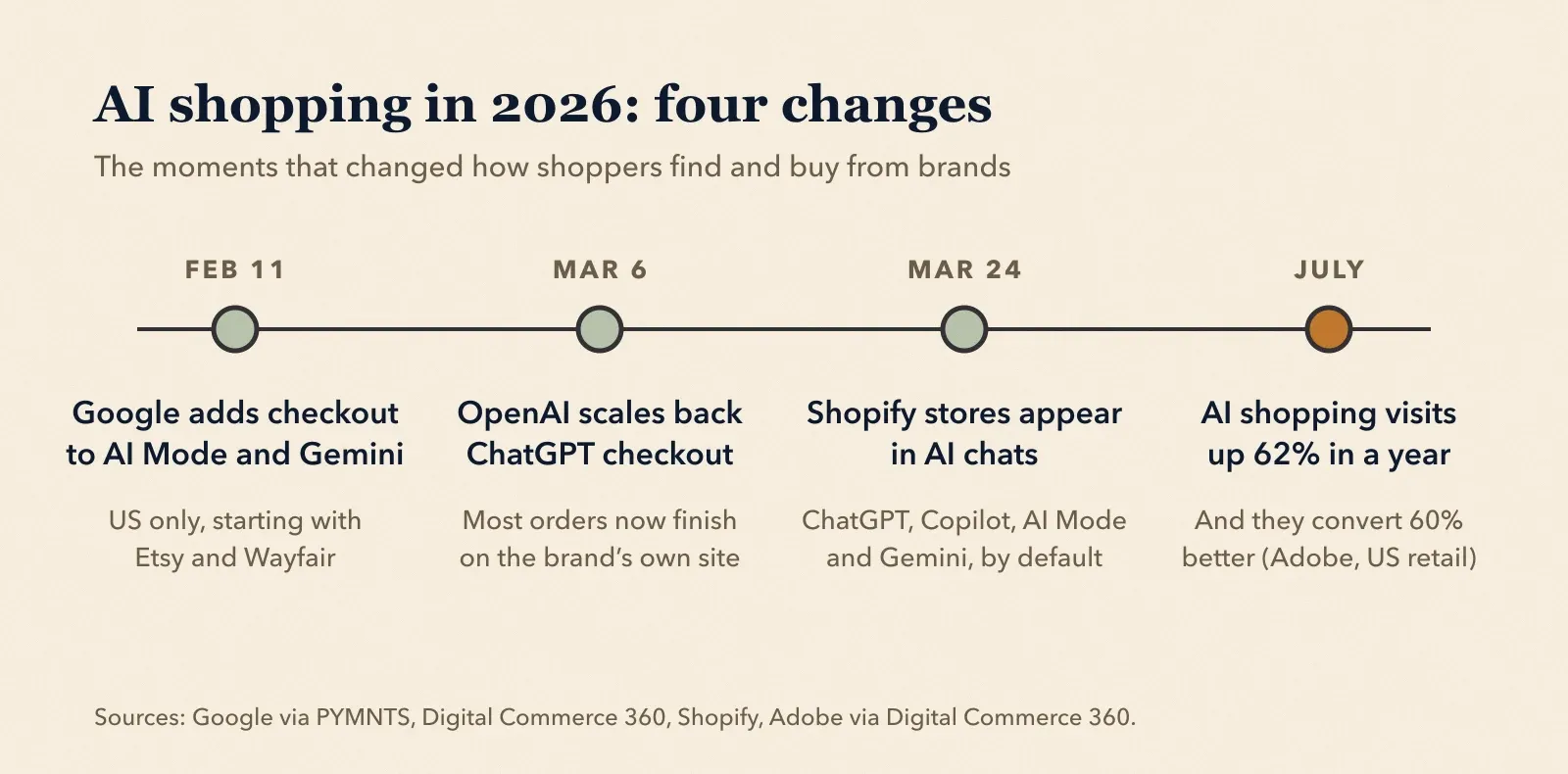
The common thread is that the AI tools are becoming the place where shoppers compare options. Your site is increasingly where they come to finish the purchase, if they come at all.
Who AI shopping answers favor
AI answers are built from sources. The tool searches the web, picks pages it trusts, and writes a summary. So the real question is which sources it picks. Several 2026 studies looked at this. They’re mostly run by companies selling AI visibility tools and their methods differ, but they point in a similar direction.
| Study | What it looked at | What it found |
|---|---|---|
| Hasmord, Oct 2026 | 55 Google AI Overviews for shopping questions | Review sites or media in 89%, YouTube in 85%, Reddit in 51%, a brand’s own site in 49%, retailers in 27% |
| LLM Pulse, Apr to Jul 2026 | 391,073 citations from ChatGPT, Gemini, Perplexity, AI Mode and AI Overviews | Major retailers and marketplaces got 2.9% of citations. Reddit and YouTube together out-cited every big retailer combined. ChatGPT cited amazon.com 6 times in the whole sample |
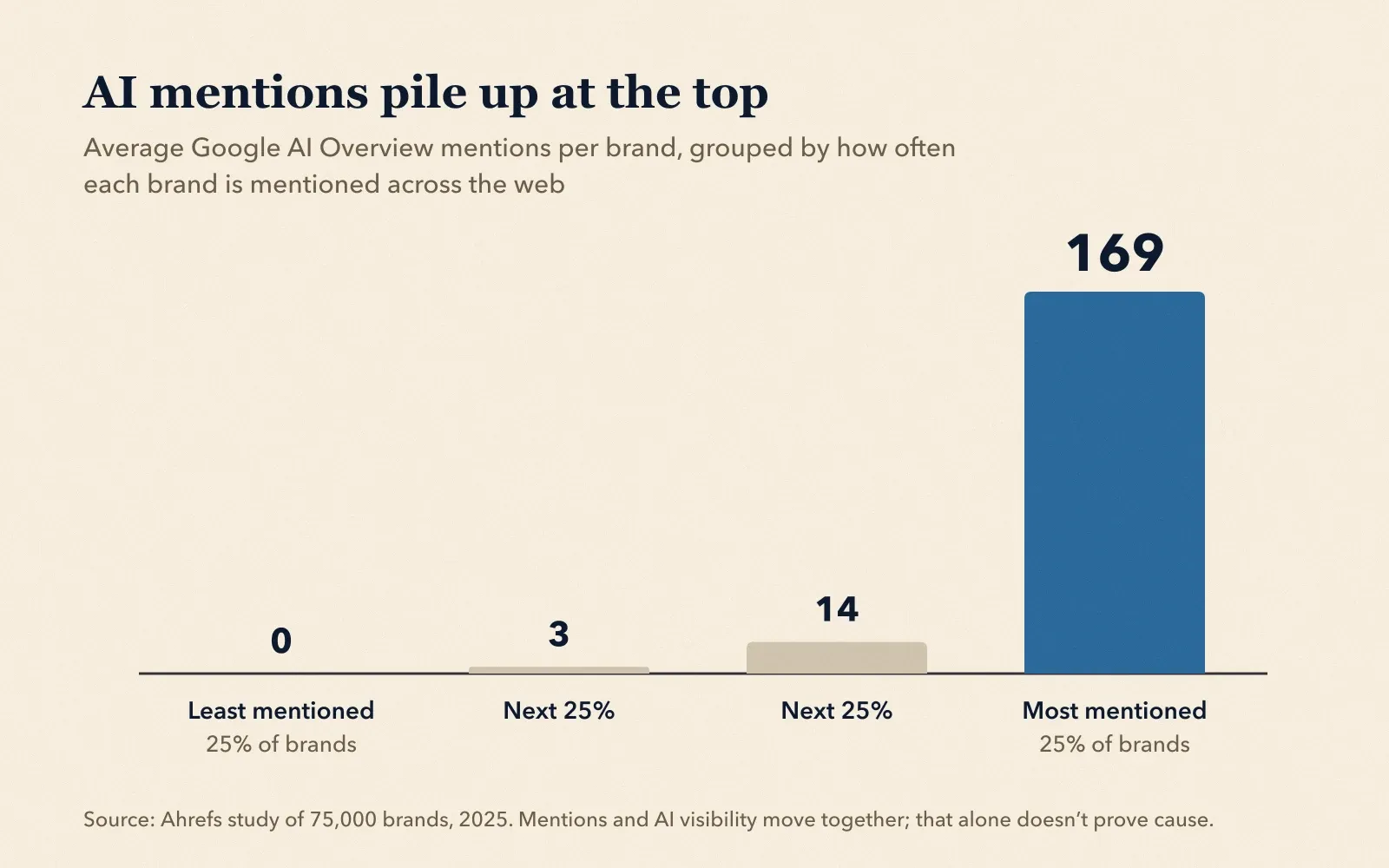
| Ahrefs, 2025 | 75,000 brands in Google AI Overviews | Brand mentions across the web had the strongest link to AI visibility, far ahead of backlinks. 26% of brands had zero AI Overview mentions |
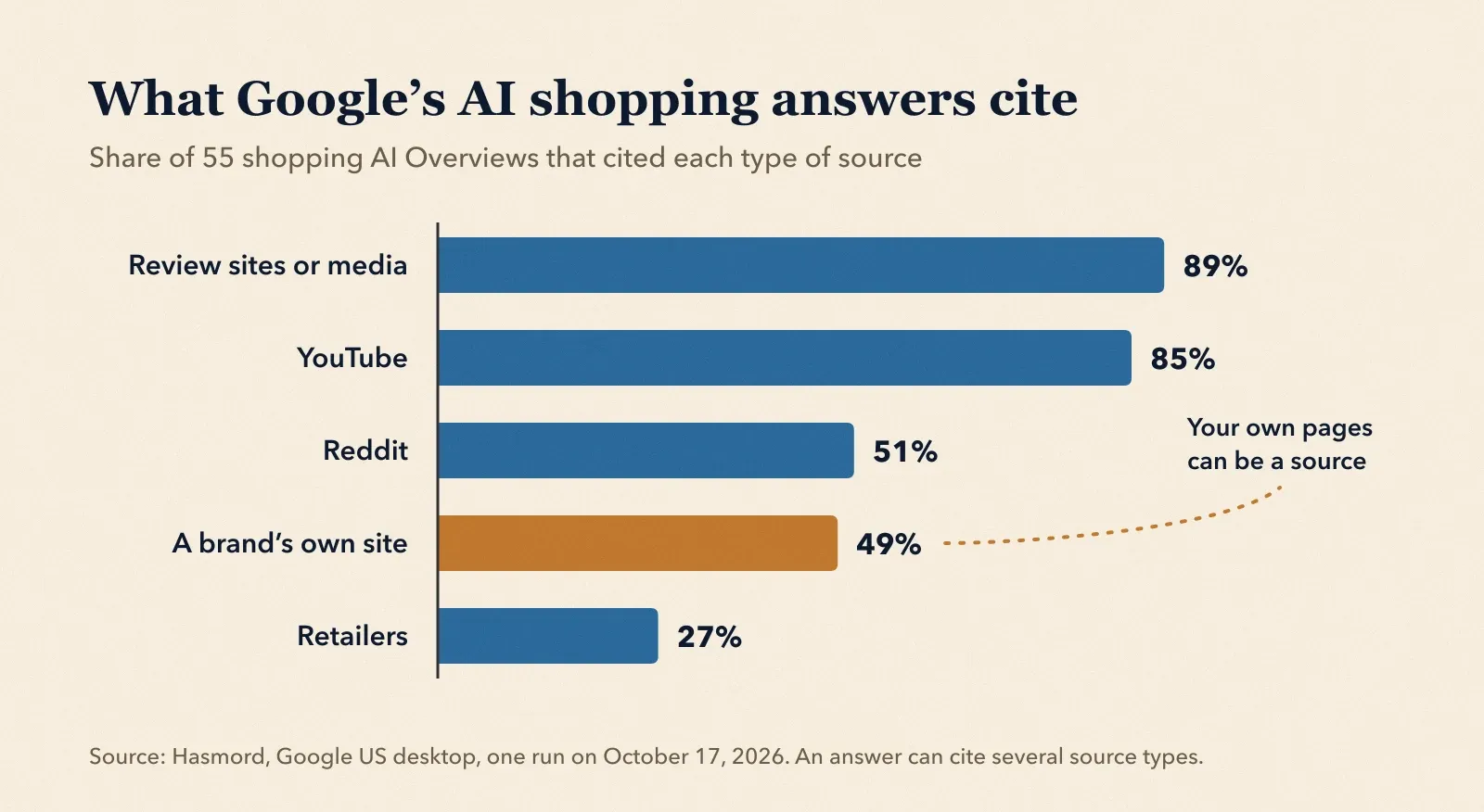
Three groups come out on top.
Community and video platforms. Reddit and YouTube show up in a large share of shopping answers. When someone asks “what’s the best X,” AI tools like to quote people who have bought X and talked about it.
Review and editorial sites. Gift guides, “best of” roundups and testing sites are the most common source type in Google’s shopping overviews.
Brands that are already talked about. This is the part that hurts small brands most. In the Ahrefs data, brands in the top quarter for web mentions averaged 169 AI Overview mentions. The next quarter down averaged 14, the one below that 3, and the bottom quarter zero. Visibility doesn’t grow gradually. Most of it goes to the brands at the top.
What surprised me is how little the big retailers dominate. You might expect Amazon to own every AI shopping answer, but LLM Pulse found ChatGPT barely cites it, and most citations point to brand sites and smaller, specialist sites. This changes quickly, though. BrightEdge’s analysis from the 2025 holidays found ChatGPT citing retailers about 36% of the time, with Amazon, Target and Walmart at the top. A few months is a long time in AI search.
So the big platforms do dominate, just in a different way than on Google. Reddit, YouTube and review media decide a lot of what gets said. Google, OpenAI and Shopify decide which catalogs get plugged in. And the brands everyone already talks about get named most often.
Why it’s harder for small brands
On Google, a small brand could win with one great product page and a few good links. AI answers make that harder for a few reasons.
The list is short. An answer names a few brands, so there’s less room at the bottom.
Mentions build on themselves. Brands that are written about get cited, which gets them noticed, which gets them written about more. A brand with no press and no Reddit threads starts from zero.
AI also needs facts it can use. If your product page is mostly lifestyle photos and two lines of copy, the AI has nothing to quote. It can’t say your earrings are nickel-free if your page never says so.
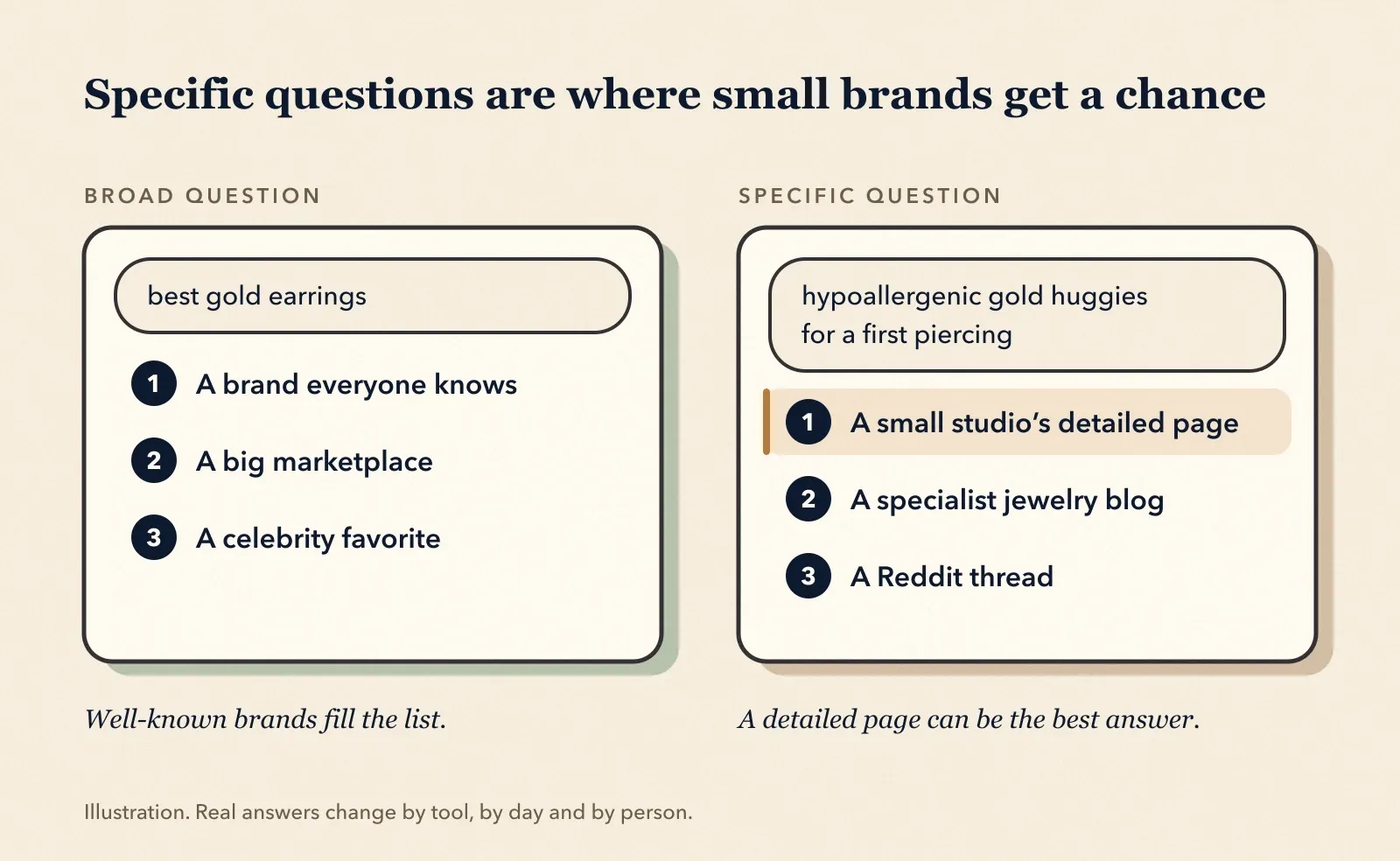
The good news is the flip side of that. Specific questions are where small brands can win. “Best earrings” is a big-brand question. “Hypoallergenic gold huggies for a teenager’s first piercing” is a question where a small brand with a clear, detailed page can be the best answer on the web.
What small D2C brands can do
You don’t need a big budget for any of this. What it takes is steady work in the places AI actually looks.
Find out where you stand first
Write down ten questions your customers would actually ask before buying, like “best beginner embroidery kit for adults” or “wall art for a small bathroom.” Ask them in ChatGPT, Google AI Mode and Perplexity. Note whether you appear, who appears instead, and which sources get cited.
This takes an hour or two and tells you more than any tool. You’ll see which competitors keep coming up and which Reddit threads, YouTube videos or roundups the AI keeps quoting. If you’d rather not do it yourself, we run a free AI answer check that does exactly this for ten questions in your category.
Make product pages answer buying questions
Go through your top products and make sure each page states the facts a shopper would ask about: materials, sizes, care, who it’s for, what it’s not for, how it compares, delivery times. Write them as text, not only on images.
A few things matter technically. Keep your Product structured data accurate and matching what’s on the page. Google also asks merchants to keep Merchant Center information up to date, and that’s what feeds its shopping features. If you’re on Shopify, check that Agentic Storefronts is switched on for the channels you want.
Publish honest buying guides
AI tools love pages that answer a question directly and compare options fairly. A jewelry brand might write “solid gold vs vermeil vs gold-plated: which is worth it?” A craft-supply brand might write “which yarn weight for a first sweater?”
Answer the question in the first couple of lines, compare honestly (including when a cheaper option is fine), and link to the products that fit. A guide that only praises your own products reads like an ad, and AI tools tend to skip ads.
Get mentioned where AI looks
This is the slowest part and the one that matters most. One reply in a Shopify Community thread summed it up: “being cited matters more than being indexed.”
- Reddit: find the threads the AI keeps citing in your category. Take part honestly, as yourself, and say who you are. Reddit communities spot and punish fake recommendations quickly, and a bad reputation there can follow you into AI answers.
- YouTube: send products to small creators who review things in your niche, or post your own how-to and care videos. In the Hasmord study, YouTube appeared in 85% of Google’s shopping overviews.
- Roundups and gift guides: pitch niche blogs, newsletters and editors who write “best gifts for” or “best tools for” lists in your category.
- Reviews: ask happy customers to review you on the platforms where reviews are public, not only on your own site.
Don’t block the bots that quote you
AI search tools send their own crawlers to read your pages, such as OpenAI’s OAI-SearchBot and PerplexityBot. Some CDN and security settings, including some Cloudflare AI-bot settings, can block them along with training bots. Check your robots.txt and CDN settings so the bots that cite pages in answers can still reach yours, even if you choose to block the ones that train models.
Skip the shortcuts
There’s no “submit to ChatGPT” button. As one reply in the same Shopify thread put it: “There isn’t a magic submit-to-ChatGPT button.” Be wary of apps promising AI rankings, paid fake Reddit posts and schema plugins that duplicate what your theme already outputs. Clear pages, honest guides and real mentions are slower, but they’re what the AI tools actually use.
How to tell if it’s working
AI traffic is easy to undercount. One reply in that Shopify thread described the usual path well: “Somebody asks for the best X for Y, sees three brands, then two days later types your brand name into Google and buys off the branded result.”
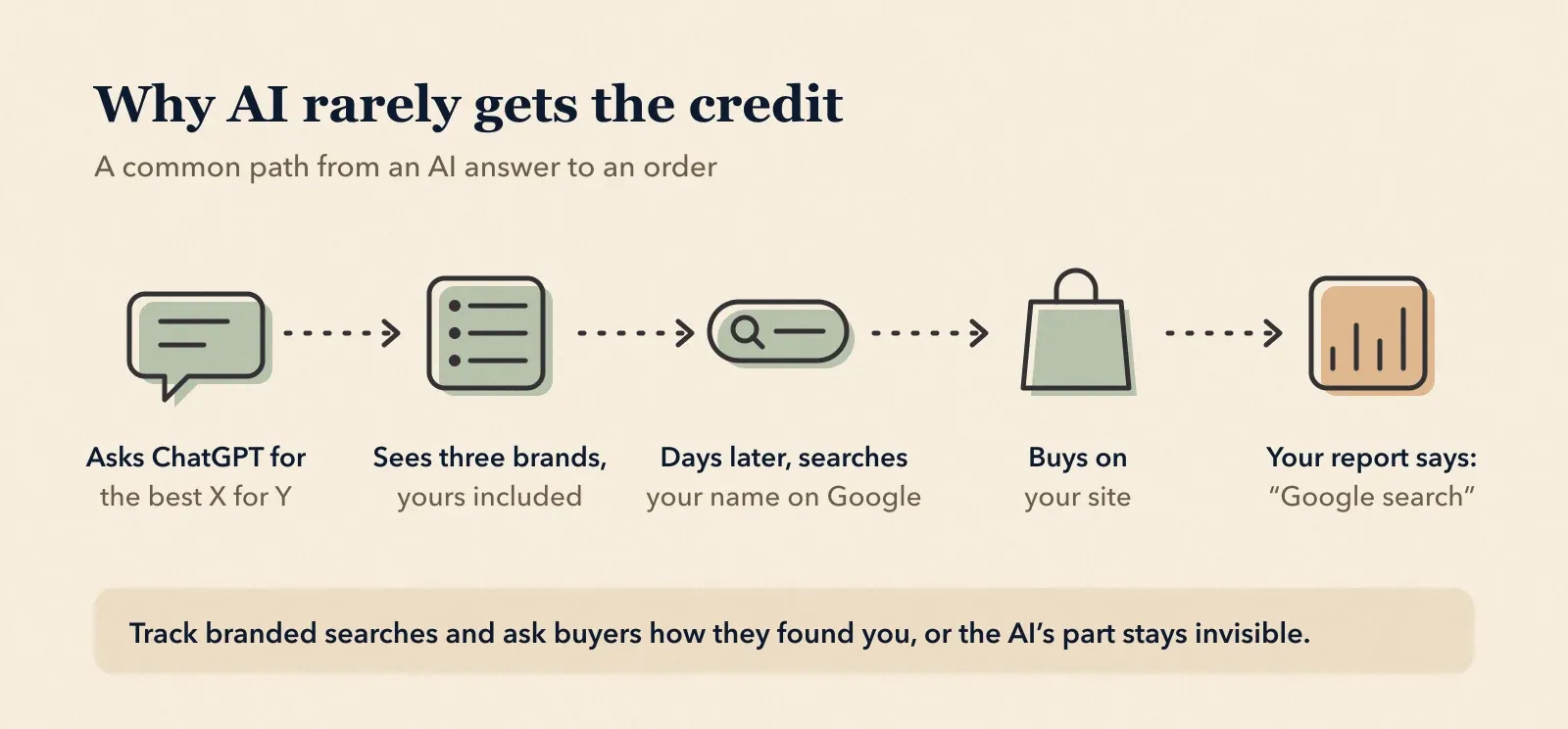
So look at more than one number:
- Referral visits from chatgpt.com, perplexity.ai, gemini.google.com and copilot in Shopify or GA4
- Branded searches in Google Search Console, which often rise when AI tools start naming you
- A “how did you hear about us?” question after checkout, with “ChatGPT or another AI tool” as an option
- Your ten questions, re-run monthly, to see whether you appear more often and in which tools
Give it a few months. Page improvements can show up within weeks once they’re recrawled. Mentions on other sites take longer.
Where this leaves small brands
AI answers are short, they lean on Reddit, YouTube and review sites, and they favor brands people already talk about. That’s a real disadvantage for small D2C brands, and it’s not going away.
But AI tools also want specific, trustworthy answers, and small brands often know their products better than anyone. If your pages answer the detailed questions, your guides compare fairly and people are talking about you in the places AI reads, you can show up next to much bigger names.
If you’d like to work through it yourself, our free search and AI answers playbook has the checklists and worksheets. If you’d rather hand it over, our search and AI service writes the buying guides and fixes the product pages described here.
So here’s a question to try this week: what do ChatGPT and Google AI Mode say when someone asks for the best product in your category? And whose name comes up instead of yours?
Common questions
What is the difference between SEO, AEO and GEO?
SEO is about ranking in search results. AEO (answer engine optimization) is about being the source an answer engine quotes when someone asks a question. GEO (generative engine optimization) is about being named or cited in answers from tools like ChatGPT, Gemini and Perplexity. In practice they overlap heavily: the same clear, useful, crawlable pages help with all three. GEO adds more weight on being mentioned on other sites.
Do I need special schema or an llms.txt file to appear in AI answers?
No. Google says there is no special schema and no extra requirement for AI Overviews or AI Mode. A page needs to be indexed and eligible for a snippet. Keep your Product structured data accurate and matching the visible page, and treat files like llms.txt as optional rather than a fix.
Can a small brand really show up in ChatGPT or Google AI Mode?
Yes, especially for specific questions. Big brands win broad questions like 'best earrings'. Small brands have a better chance with detailed ones like 'hypoallergenic gold huggies for sensitive ears', where a clear product page or guide is the best answer available. Mentions on Reddit, YouTube and niche roundups make it more likely.
How do I know if ChatGPT is sending me customers?
Look for chatgpt.com, perplexity.ai and gemini.google.com in your Shopify or GA4 referral reports. That number is usually an undercount, because many shoppers see your brand in an answer and later search your name or type your URL. Track branded searches in Google Search Console and add a 'how did you hear about us?' question after checkout.
Can I buy directly inside ChatGPT or Google's AI Mode?
Partly. Google launched checkout in AI Mode and the Gemini app in the US in February 2026, starting with Etsy and Wayfair. OpenAI scaled back ChatGPT's Instant Checkout in March 2026, so most ChatGPT purchases now finish on the merchant's own site. Shopify stores can appear in ChatGPT, Copilot, AI Mode and Gemini through Shopify's Agentic Storefronts.
How long does AEO or GEO take to work?
Expect months, not weeks. Improving your own pages can help within a few weeks once they're recrawled. Earning mentions on Reddit, YouTube and review sites builds slowly. Re-run the same set of buyer questions each month so you can see whether you're moving.
Sources & further reading
- Google Search Central: AI features and your website ↗
- Digital Commerce 360: Adobe AI referral traffic data, July 2026 ↗
- LLM Pulse: Where AI actually sends shoppers (391,073 citations, April to July 2026) ↗
- Hasmord: Who Google AI Overviews cite for shopping (October 2026) ↗
- Ahrefs: An analysis of AI Overview brand visibility factors (75K brands studied) ↗
- BrightEdge: Google vs. ChatGPT citation patterns for shopping (December 2025) ↗
- Shopify: Agentic commerce momentum (March 24, 2026) ↗
- Digital Commerce 360: OpenAI shifts checkout plans in its agentic commerce strategy ↗
- PYMNTS: Google launches agentic commerce with Etsy and Wayfair ↗
- Shopify Community: Getting traffic from ChatGPT and AI agents, where do I even start? ↗
Written by Omar Sohrab with AI assistance for research and editing. Figures come from the linked studies, most of which are run by companies that sell AI visibility tools. Their methods and dates are noted where they matter. Community quotes were checked against the original thread.

Omar Sohrab
Omar works across content strategy, search and technical operations. He connects useful publishing with the systems that help people discover it.
Author profile ↗PUT IT INTO PRACTICE
Put the idea to work.
Want help with the work behind a consistent brand presence? Explore the services and choose the support that fits.
Explore our services ↗A correction or a question? Let us know. Read our editorial policy.

